




Blog overview
Start using SimpledCard immediately?
Check out our packages or contact one of our experts directly!
Expense allowance, travel allowance, per diem, whatever you call it, all these terms refer to claimable expenses. Making expenses is part of the job, but how do you arrange their reimbursement? Does everyone know how to claim expenses? Are those reimbursements taxed? And how do you make sure everything is processed smoothly and correctly?
Fortunately, you are not alone. Here are the answers to these questions and some tips on how to arrange expense reimbursements efficiently within your organisation.
What is an expense allowance?
Expenses are costs that employees (have to) incur to perform their jobs. For this, they then receive a reimbursement or compensation. This is often called an expense allowance.
Examples of expenses employees can claim are:
- allowances for travelling to the workplace and back home;
- a course or study they do as part of their job;
- the use of a company phone.
There are even companies that offer employees an expense allowance to stay healthy, where they can claim the cost of their sports sessions or clothing.
It can vary by organisation and type of expense whether an employee receives an allowance, which is often the case for commuting expenses, or a full reimbursement. An employee must first submit a claim for expenses incurred before a reimbursement is made. This is an accounting of the expenses incurred.
Untaxed expense allowances
There are two types of expense allowances, taxed and untaxed. At taxed expense allowances payroll tax and national and employee insurance contributions are withheld and remitted.
As an employer, you will not often deal with taxed allowances. This is because the most common expense allowances, such as travel, meals or accommodation costs, do not qualify as wages.
Above all, what you need to consider as an employer is untaxed expenses. These are regulated through the working expenses scheme (WKR).
The WKR is a tax scheme that allows you to give your employees untaxed allowances, both in salary and in kind. Expenses covered by the WKR include:
Travel allowanceUp to €0.21 per kilometre (as of 2024) tax-free.
Meals at overtimeOnly tax-free if it meets the Tax Office's conditions.
Home working allowanceIn 2024, the tax-free home working allowance will be €2.35 per day.
However, these untaxed expense allowances must fall within the free space of the working expenses scheme. If this limit is exceeded, payroll tax must be paid on them.
Taxed expense allowances
If an allowance does not fit within the WKR, it is considered wages and must be subject to payroll tax. This applies, for example, to:
- Bonuses or gratuities which are paid out as ‘expense allowances’.
- Cost of personal expenses, such as private purchases through a business account.
To avoid unexpected tax charges, it is essential to establish a clear policy on which allowances are tax-free and which are not.
Claiming costs incurred efficiently
All expenses incurred should always be accounted for, also known as a claim. It is important that a claim always indicates what expenses were incurred so that it can be entered correctly.
Indeed, a wrong declaration can haunt a company for many years. The tax authorities apply a hefty correction: monthly allowance x the number of employees x 12 months x 5 years.
Moreover, you want to prevent employee fraud. By drawing up clear rules and a clear procedure, you can avoid many problems, extra work and costs. Read here how to draw up such a declaration policy for your organisation.
There are several ways for employees to claim expenses:
Fixed expense allowance
In addition to receipts claiming expenses already incurred, it is also possible to give a fixed expense allowance. This can be based on travel costs from home to the workplace, for example. The fixed allowance is then paid on top of the monthly salary.
✓ The advantage of this is that you save a lot of time and manual work.
✗ However, you should carefully assess the level of compensation and regularly check whether it is not too high or too low, and whether it still suits the employee's situation.
Expense reimbursement on a claim basis
This means that after incurring the expense, employees request an expense allowance with proof of the expense, such as a receipt or invoice. This is often done through a paper or digital claim form.
✓ The advantage of this is that these costs do not have to be estimated in advance and you are only reimbursed for the costs incurred.
✗ These costs vary, making them more difficult to oversee. For this, you can set a time limit within which employees must claim after incurring the costs.
Employer pays expenses directly
It is also possible to offer employees a payment card from within the organisation, so employees never have to advance expenses themselves. Claims are made via a linked app.
✓ Employees don't have to pre-pay out of their own pockets, which also means less work for the finance team, as you don't have to manually match claims.
✗ This option does require trust in employees, as the money has already been spent before the claim is made.
Digitising expense claims
As described in the last example, it is also possible to digitise the entire expense process. If your organisation has to deal with expense claims more frequently, this is the simplest solution.
[ text continues below image ]
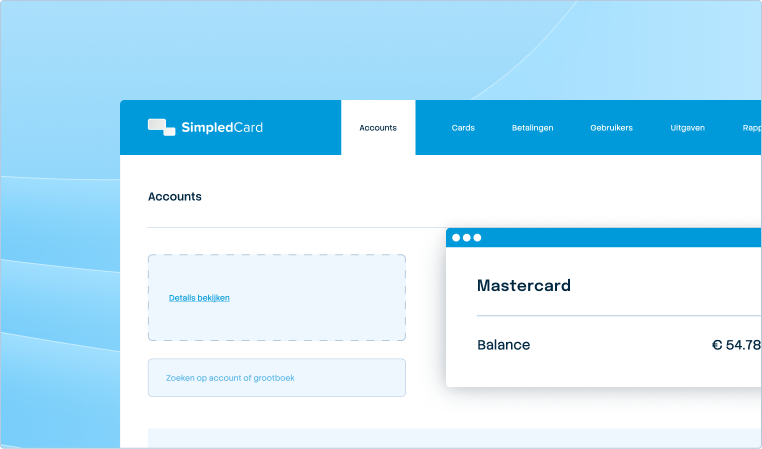
Digital payment card with claims app
One of the most efficient digital solutions is to offer a business prepaid debit card containing a certain budget that the employee can spend. This can be a fixed expense allowance per month, or you determine it based on activities or projects. The budget on the card can be automatically topped up monthly or to a specific amount.
These prepaid cards are linked to a claims app. All transactions made with the card are then automatically linked to an accountability. The process is simple: the employee takes a picture of the receipt and in the app only adds a description, VAT rate and cost type/place. This saves a lot of manual work.
All receipts that are uploaded are also stored digitally. It is very rare anyway that organisations keep physical receipts of meals and travel expenses. But with a solution like SimpledCard's, these are kept for you in the system for at least seven years.
Declaring expenses thus becomes a lot faster and easier for employees. Apart from that, you yourself as finance team have full control and insight into expenses. The entire process is thus completely streamlined for all teams.
Do you want to digitise expense claims within your organisation? During a demo, one of then of our experts will show you the app and Card Management System. Beal together what the benefits are for your organisation when you digitise expense accounting.

FAQ
What expenses are employers allowed to reimburse tax-free?
Employers are allowed to give tax-free reimbursement of certain expenses under the Work-related Costs Regulation (WKR), such as travel expenses (€0.21 per km), home working allowance (€2.35 per day) and business meals. Always check the latest rules from the Tax Office.
How does the working expenses scheme (WKR) work with expense allowances?
The WKR determines which expense reimbursements are tax-free. Employers are given a margin (percentage of the wage bill) for tax-free reimbursement of expenses. If you exceed this space, you pay 80% tax on the extra amount.
How to avoid errors in expense claims?
Common mistakes include missing receipts, incorrect VAT deductions and misapplication of the WKR. A clear declaration policy and a digital declaration system help minimise errors.
How do you digitise the claims process?
With a digital claims system, employees can easily submit their expenses, approvals are accelerated and you avoid administrative errors. Automation saves time and increases reimbursement control.
How long should you keep expense claims?
According to the Tax Office, companies must keep financial records, including declarations, for at least seven years. This prevents problems during a tax audit.
