




Blog overview
Start using SimpledCard immediately?
Check out our packages or contact one of our experts directly!
The well-known saying ‘you need to spend money to make money’ applies especially to businesses. You cannot start a business without incurring costs. You will need money for materials, inventory, office space and staff recruitment, among other things.
Apart from start-up costs, there are also many ongoing costs that companies have to pay. At least, if they want to stay afloat.
Growing organisations need to plan their financial path ahead. Finance teams know when their business will break even. And what cash level is sufficient to pay for production and operating costs.
This is all necessary before the company can actually achieve a positive operating result.
Every kind of business has varied expenses that it has to incur. Let's take a closer look at the types of expenses and how to manage them.
❯ What are operating expenses?
- Operating costs
- Non-operating expenses
❯ Understanding operational costs
- How do you calculate the operating expense ratio (OER)?
❯ How do you manage operating costs?
❯ The automation of business expenditure
❯ Must-haves for your cost management system
What are operating expenses?
Expenses can be simply described as the outflow of money. From one business to another. Expenditures are made to purchase goods and services.
You can split expenses into two categories. Operational and non-operational expenses. Properly managing these expenses is very important for a company's financial health. This is because if expenses are structurally higher than revenues, the business has no chance of succeeding.
Sale
- Cost of goods sold
------------------------
= Gross profit
- operating expenses
------------------------
= Operating income
+/- Exceptional operating expenses / revenues
------------------------
= Net profit
Operating costs
All costs, which are incurred to keep a business running, are counted as operational costs. These are costs that a company is forced to incur.
Expenses incurred during production are not counted as operating costs. That kind of expenditure falls under the ‘cost of goods sold’ (COGS).
To cover operating expenses, an organisation needs to make payments from the money it holds. This is why cash flow is so important. If a company does not have enough cash flow, it can only take out limited loans.
Not all businesses have the same kind of operating costs. A cleaning company has different costs from a construction company.
The size of a company also affects its operating costs. A one-man construction company will have lower costs than a large construction company with branches in several countries.
Non-operating expenses
Costs, which are not related to the core activities of your organisation, are called non-operational costs.
There are several types of non-operating costs. The most obvious are capital expenditure, or investment capital. These are investments that are capitalised or depreciated over a long period of time. For example, the purchase of large machinery or equipment. Or a patent.
Non-operating expenses also include:
- financing costs, such as interest on borrowed money;
- asset write-downs;
- loss on sale of assets;
- charges for foreign currency exchange, etc.
One-off expenses are often non-operational costs. For example, you can characterise the cost of moving your shop as such.
Other examples include incidental costs for legal advisers, management consultants, etc. Especially if these are engaged in connection with a restructuring. Or take, for example, a company paying for COVID tests for employees. These are also non-operational expenses.
The split between operational and non-operational costs is important. You can only properly see your company's true financial performance if you list the two types of costs separately. That way, you avoid errors in your financial projections.
Operational costs made transparent
In general, most companies face some or all of the below operating costs.
Staff wage costs are one of the most basic expenses. The more people a company employs, the more it has to pay in salaries.
And do you have to add the associated costs. Such as fringe benefits, health insurance, allowances and so on.
Office space costs are also a big part of operating costs. Such as rent, maintenance, office supplies and gas, water and light. These costs are lower or higher depending on the size of the business.
A company with multiple locations will have much higher expenses for this than a company with just one office.
Companies also sometimes spend significant amounts on marketing and advertising. While these can be adjusted during a bad month, they are still operational costs.
The level of this cost depends on the industry your business operates in and the target audience you want to target. The more competition, the higher the cost. And that to ‘just’ get your message across to potential customers.
Most common operational costs:
- Pay
- Pension contributions
- Office rental and maintenance
- Business equipment
- Office supplies
- Gas, water and light
- Insurance
- Car costs
- Business travel
- Sales commissions
- Marketing materials such as brochures
- Advertising (including Facebook/Google/etc)
But how do you compare your company's performance with competitors?
Relying on the total number of sales at the end of the month does not provide an accurate picture. It is the operating expense ratio (OER). Or also called operating cost ratio. It reveals how your organisation is doing compared to others in the industry.
How do you calculate the operating expense ratio (OER)?
The operating expense ratio, or so-called OER, provides a comparison of your expenses with your income. It is a measure of how much income is spent on operational and production costs.
A low OER means less revenue is spent to cover costs. And that is usually a good thing.
The formula to calculate the operating expense ratio is:
(Price of Goods Sold + Operating Costs) / Revenues = OER
Example:
| Revenue | € 400.000 |
| Price of goods sold | € 100.000 |
| Operating costs | € 140.000 |
Using the above numbers, the formula gives you an OER of 0.6. That means that of every euro earned, the company spends 60 cents on costs related to running the business.
Compare your company's OER with industry benchmarks to see if your results are good or bad.
A high OER compared to others may indicate a decline in your company's operational efficiency. You will then want to take measures to increase returns. And thus bring down the OER.
How do you control your operational running costs?
As we have seen, your profitability partly depends on operating costs. If these are higher, your company will make less profit. There are some, but limited, ways for companies to try to increase profitability.
A. You could raise prices to increase margins. But that is also risky. Customers may not be willing to pay higher prices for the same product.
A price increase could prompt them to switch to a competitor. So even if higher prices lead to more revenue, the loss of sales could negate that.
B. Another way to improve margins is to reduce the cost of goods sold. In that case, you need to get more efficiency out of the supply chain.
For large manufacturing companies, this is a fairly standard process. And their suppliers can manage this relatively easily due to economies of scale.
However, it can have a negative impact on the quality of your product. For example, if cheaper labour or raw materials are used.
Customers, for whom the quality of a product is important, may switch to a competitor in that case. Especially if the lower-quality product is sold at the same price. Or even at a higher price than before.
That is why when organisations want to increase their margins, they usually look first at how to cut operational costs.
A thorough analysis of all expenses often reveals where you can still make savings. Without reducing quality or increasing prices.
The outsourcing of work is a proven way to reduce operational costs.
All large multinationals are doing outsourcing. They move customer service teams and online helpdesks to countries where it is cheaper. This often leads to savings in other areas as well.
If the entire customer service team is based in another country, the company can move to a smaller office. This saves rent, office supplies and gas, water and electricity.
Many companies also have high expectations of Artificial Intelligence (AI) to make processes more efficient. With artificial intelligence, they try to automate certain tasks.
‘Bots’ trained by machine learning will then perform tasks such as scheduling appointments or reconciling bank statements completely independently. What in the past required complex spreadsheets and/or manual operations might be set up that way in the future.
The automation of business expenses
Automation can also play an important role in managing business costs. Software to track and monitor staff expenses can help enormously in reducing business expenses.
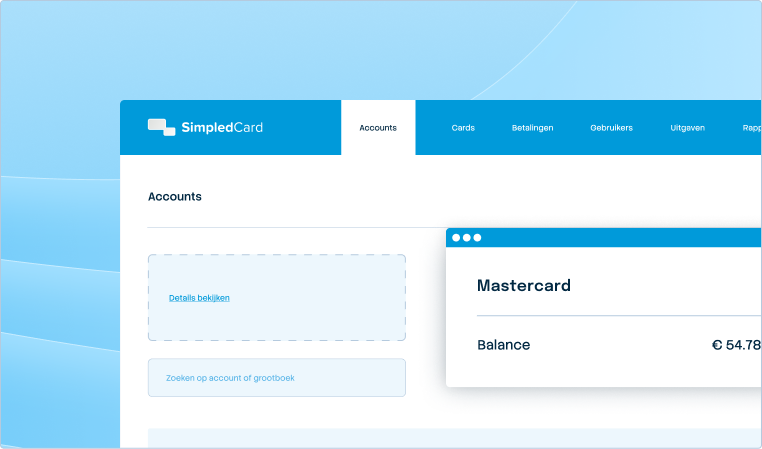
An integrated expense management tool, such as SimpledCard's platform, can make a big difference. Organisations can issuing and linking payment cards to the smart software solution.
Payment cards are quickly issued and flexibly allocated to employees. With preset limits, there is always clarity about the company's financial spending.
The cards can be upgraded in real time. The balance on the debit card is then increased in seconds. For example, if an employee suddenly needs to incur an unforeseen business expense.
The smart expense software gives you access to the latest transaction data through real-time reporting. And you can also integrate the SimpledCard platform with your ERP and accounting systems for automatic data exchange.
Role-dependent approval processes are made transparent, leading to better governance. Finance managers have the ability to instantly see all business expenses.
The platform also makes it easier for employees to justify their business expenses and submit receipts. This can all be done via the mobile app. Purchase receipts can be uploaded and tagged on the go.
Must-haves for your cost management system
Your organisation should have an expenditure management plan. Such a plan outlines all the processes that help optimise spending against business activities.
These are not things like payroll or standard operating expenses, but rather such an expenditure management policy helps to reduce non-necessary or avoidable expenses.
This could include incidental expenses, monthly software subscriptions, travel expenses or other items. For example, a company might limit the number of, not really necessary, business trips and ask sales managers to hold more virtual meetings instead.
The moment employees get a company payment card, the expense rules dictate what they can and cannot spend money on. You can then assign specific cost types and budgets per team or employee.
Accounting for expenditure
Employees must account for the expenses they incur using debit cards. In addition, they may still have to submit a claim if they have advanced money from their own pocket for a business expense.
A good expense management system should automate and make accounting for all these transactions easier. SimpledCard's system does just that. By providing a simple way of accounting for expenses.
After paying by debit card, employees immediately account for the expenditure. They do this by taking a picture of the purchase receipt via the app and justifying the transaction in the app.
Finance managers thus have insight into all expense claims via a single dashboard. And can quickly retrieve additional information as needed.
This way, cost claims go quickly and easily. Both for your company and for your employees. They no longer need to keep dozens of receipts. Or waste valuable time on administration.
Employees immediately justify expenses via the mobile app. And allocate previously established cost types.
Insight into expenses for finance teams
Finance managers benefit from real-time reporting. They have full visibility of payment cards and all transactions. All claims are immediately submitted for approval.
There is no more paperwork, which required endless scanning of receipts and other documents. And they no longer have to chase employees for missing receipts.
Everything is done digitally and in real time. In addition, you can easily split lines or add comments to certain expenses. This gives you accurate accounting. Transactions are sorted and filtered for ‘bulk actions’.
An organisation consisting of multiple entities can set up different environments in SimpledCard's platform. With separate accounting for each entity, you keep accurate records of expenses.
All relevant VAT levels, cost types and cost centres are quickly assigned per account. And you set your own rules. Such as automatically replenishing budgets allocated per card.
With the insights provided by SimpledCard's system, you get more control over your business expenses. You make the expenditure management process more efficient. And your employees themselves contribute to optimising their spending. All great steps towards lower OER!
Do you still have questions about operating expenses? Or how best to manage your organisation's expenses? Then feel free to contact us for an informal discussion. Together with one of our experts, you will look at what your business needs and draw up a plan together.


Published on: May 11, 2021