





Blog overview
Start using SimpledCard immediately?
Check out our packages or contact one of our experts directly!
Assets and liabilities are the components of the balance sheet. Together, they give a clear picture of your organisation's financial health. But what exactly do these accounting terms mean? And why must they always be equal to each other?
In this blog, we explain what assets and liabilities are, and how they help you accurately map your organisation's financial situation.
What is the difference between assets and liabilities?
The balance sheet shows assets on the left (debit side) and liabilities on the right (credit side).Assets show what your organisation owns, such as money in the bank, company cars and stocks. Liabilities show how these assets are paid for, such as equity or loans. Simply put: assets show what you have, and liabilities show how you financed it. It is important that these two are always in balance, so that you have a right image have of your organisation's financial situation. If the balance sheet is unbalanced, it means there has been a mistake in the accounts somewhere.
Assets disbursedlegd
Assets are all the possessions of your organisation and are at the left side of the balance sheet. These assets can be divided into two categories: fixed assets and fluidnde assets.
Fixed assets
Fixed assets are long-term investments that you hold for more than one year. For example:
- Property, plant and equipment:These are tangible assets such as business premises, machinery or vehicle fleet.
- Intangible assets:These are non-tangible assets, such as patents, brand names or intellectual property.
- Financial fixed assets:These are financial assets, such as shares in another company or long-term loans you have made.
Current assets
Current assets are possessions that you convert into cash in the short term (within a year). You can divide them into:
- Stock: This includes purchased products, parts, packaging materials and work in progress (work in progress). For the latter, think of a construction project in progress for which an invoice has not yet been sent. These items are temporarily part of your inventory until they are sold. After the sale, you send an invoice, and they become part of your accounts receivable.
- Debtors: These are the customers who have not yet paid for the products or services they have received. In other words, these are outstanding invoices. This is money to which you are entitled and the expenses have already been incurred. Therefore, you may add this amount to your assets.
- Cash and cash equivalents: This is the money you have readily available, such as money in the business bank account, credit card account or cash on hand.
- Accrued assets: Think of prepaid services or products yet to be delivered, such as an insurance premium.
Liabilities explained
Liabilities are on the right side of the balance sheet, also called the credit or debt side. They show how assets have been paid for. So liabilities reflect your organisation's financial liabilities, but they also include your equity. Liabilities consist of:
- Equity:An organisation's equity is the difference between an organisation's assets and liabilities. In other words, assets minus liabilities.
- Long loan capital:These are debts with a maturity of more than one year, such as a mortgage or other long-term loan with a bank.
- Short-term debt:These are debts with a maturity of less than one year, such as outstanding supplier invoices or outstanding taxes.
- Amenities:This is where expected future expenses are included, such as a retirement reserve. These are expenses whose exact amount or timing is not yet certain, but which you know will come in time.
Why must assets and liabilities always be equal?
The activities and liabilities form the basis of your balance sheet. If you add total assets and total liabilities, the balance sheet total should be equal on both sides. This balance is important for finance managers to get a clear picture of the financial health of the company and informed decisions to can take. We'll give you an example: you buy a new machine worth €50,000. This amount is added to your assets because you have a new asset. The machine is financedcierd with a loan, increasing liabilities by €50,000. This keeps the balance sheet balanced: the assets show what you own, and the liabilities show how you financed that asset.
What if assets and liabilities are unequal?
Als the balance sheet totals of the assets and liabilities not same its, you need to take action. Suppose your debts, as salaries, loans and office building rent, exceed the value of your assets, such as equipment, stock and bankbalance. In that case, you have negative equity. This means that your liabilities are not fully covered by your assets and that your organisation possibly not to the can meet financial obligations. For finance managers this is an important signal to act, e.g. through cost verlagen or attract additional funding, to restore financial get.
Business prepaid cards for optimum expenditure management
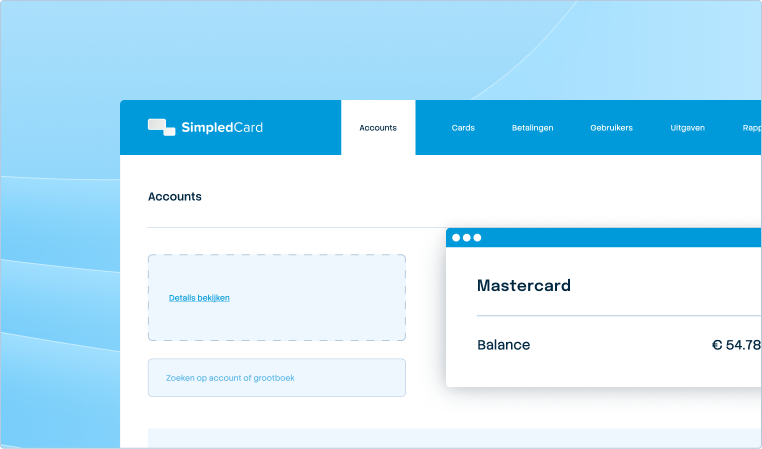
A smart way to keep a grip on your current assets, such as cash, is to use the corporate prepaid cards from SimpledCard. These cards allow you to easily allocate budgets to employees, teams or departments, giving you more control over spending and avoiding unwanted surprises.
The corresponding Card Management System gives you in real time insight into all transactions, so you can immediately see where the money is going and make timely adjustments. In addition, it integrates our platform seamlessly with various accounting programmes, ensuring efficient processing of your financial data. This makes managing the assets and liabilities of your organisation not only simpler, but also more accurate.
Schedule a demo
Will you get a better grip on your operating expenses and ensure a balance between assets and liabilities? Find out how our prepaid business payment cards from your organisation can help optimise spending management.
FAQ
What are assets and liabilities?
Assets are all the possessions of an organisation, such as machinery, stock and bank balances. Liabilities show how these assets have been financed, for example with equity or loans.
What is the difference between assets and liabilities?
Assets show what an organisation owns, while liabilities show how these assets have been paid for. Assets are on the debit side of the balance sheet, and liabilities on the credit side. They should always be balanced.
Why must assets and liabilities be equal?
Assets and liabilities must be balanced to give an accurate picture of an organisation's financial health. Unevenness can indicate errors in accounting.
What to do when assets and liabilities are not balanced?
If assets and liabilities are not equal, this may indicate negative equity. Possible solutions include cost reduction, additional funding or detecting errors in the accounts.
What are business prepaid cards and how do they help with assets?
Business prepaid cards, such as those from SimpledCard, help manage current assets such as cash. They provide real-time visibility into expenses, improve budget management and integrate with accounting systems.
