




Blog overview
Start using SimpledCard immediately?
Check out our packages or contact one of our experts directly!
Does your finance-department already agile? If not, it's about time. Because it will allow you to help customers faster and better. Agile working changes the approach and role of your financial professionals. Vfrom watchdog to cartwright.
Agile working is a way of breaking down complex or wide-ranging issues into manageable blocks, and working on them block by block as a team.
Globally, more and more organisations are opting for this agile way of (collaborating) working, which has come over from the tech sector.
Why?
Agile working helps teams plan better, collaborate more smoothly and move much faster.
Want to know more about agile working? Watch this short introductory video.
What is agile?
Agile is a way of working that focuses on flexibility and responding quickly to change. This way of working originated in the ICT world. In it, software is developed in short periods, called ‘sprints’. After each sprint, which lasts two to four weeks, the team delivers a working product. The customer provides feedback, after which the team adapts the software. This ensures rapid real-world testing and more value for the customer.
In 2001, seventeen software developers proposed the Agile Manifesto on. This document contains four core values:
- People and their interactions over processes and tools.
- Working products above comprehensive documentation.
- Working with clients over contract negotiations.
- Responding to change over following a plan.
These values form the basis for 12 principles that provide guidelines for effective working.
Agile working offers several advantages:
- High product quality: Regular testing during development ensures quick adjustments and awareness of any problems.
- Improved project control: Through sprint meetings and transparency.
- Reduced risks: Short cycles make it almost impossible for a project to fail completely.
Methods such as Scrum and Kanban help apply Agile principles in organisations.
Why agile working is important for finance teams
Agile working is now nothing new under the sun. Organisational and operational agility are more important than ever. This makes working in short cycles more and more the norm.
Consequently, many organisations worldwide have gone through or are in the middle of an agile transformation. Financials are indispensable in this, as their work touches many internal processes. An agile approach offers all kinds of practical tools to make your financial teams work together more closely and smoothly. With each other, and with other disciplines within your organisation.
Finance's controlling function becomes a natural part of the planned tasks that agile teams work on every week. As a result, finance professionals are always involved from A to Z. Whether it's about overview investments or more risky (but much-needed) innovation projects.
This way, you improve budgeting and accountability together, and keep a grip on financial-strategic planning. This ultimately leads to better output, more satisfied employees and extra value for customers.
Agile in finance? No time to lose
Switching to agile working methods takes time, focus and perseverance. Nevertheless, Agile expert Rini van Solingen advises finance departments to get started quickly:
“Wherever finance professionals have influence on lead time, they will eventually start working agile. There is no escaping this, because in today's dynamic markets, customers expect speed and agility.”
Take steps towards an agile finance team
Within an agile organisation, the focus shifts from process and cost control to result and value control. The goal is no longer ‘do the same thing with less money,’ but ‘get more out of existing resources.’
From this idea, agile teams are formed, working on concrete goals with fixed budgets. Here, preferably no separate budgets are allocated to departments and projects, but rather budget ideally at the level of the value chain.
Allocating large amounts for longer periods at an early stage then happens less and less. And as viscous working methods are shaken up, projects are henceforth divided into manageable cubes and controllers collaborate with other disciplines, tasks and roles within your internal finance structure change.
To arrive at a new division of roles, you need to involve all relevant parties. From finance to controlling at all levels: financial, project, business and corporate.
Take stock of what your finance professionals are currently doing and what you need them to do in the future. This immediately provides a good opportunity to have a conversation with them about their talents, motivations and competences.
Do they feel at home in an innovative organisation and can they let go of systems thinking? Then the next step is: making sure the team functions optimally. Hence, the introduction of agile working often leads to the use of new software and systems.
Streamline your processes with smart agile finance tools
Strategy firm McKinsey calls complexity the enemy of agility, and encourages organisations to learn from agile IT departments.
Preferably, as few people as possible are involved in decisions there. And professionals there use smart tools to simplify, automate and streamline processes, such as:
- Trello and Asana are online platforms that help agile teams achieve concrete results faster. Among other things, by making mutual workflows transparent, simplifying task management and facilitating collaboration.
- Agile project management tool Jira is set up for optimal collaboration during software development. Through this digital platform, teams can plan, track and deliver projects in a streamlined way.
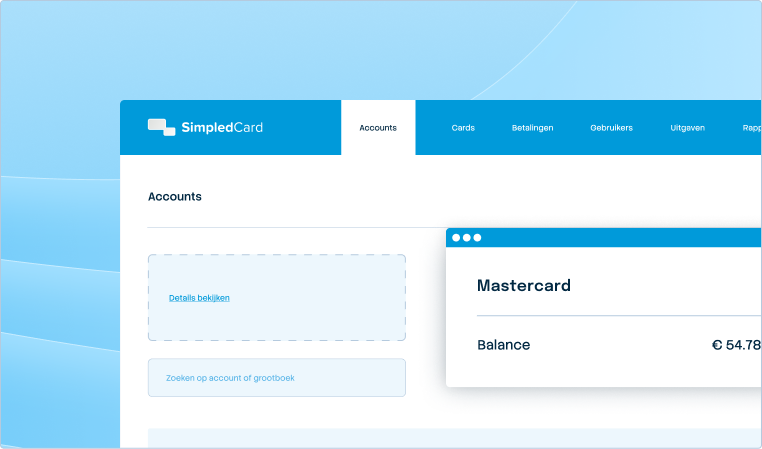
- With payment and claims platform SimpledCard make finance and control in an agile environment easier. You always and everywhere have insight into business expenses, thereby keeping a grip on cash flows.
Agile finance solution for business expense management
With SimpledCard, finance teams keep a grip on payments and declarations. Thanks to a clear, user-friendly and transparent platform, to which you can easily bank-independent payment cards links.
Because your finance professionals keep an overview and make decisions based on real-time data, they identify trends, mitigate risks and create opportunities.
Thus, they help colleagues move forward and increase the agility of your organisation. This leads to more appreciation for finance professionals within your agile teams.
Contact us about your agile finance transformation
Wondering how to easily implement SimpledCard within your agile organisation to make your finance department more agile and get a quick grip on your business expenses?
Our financial experts will be happy to work with you to see which solutions fit your organisation, wishes and ambitions.

News - Agile finance

Published on: November 25, 2024