




Blog overview
Start using SimpledCard immediately?
Check out our packages or contact one of our experts directly!
From Christel Heije on 20 July 2021
As a finance manager, you want your organisation to have little to no financial risk. At the same time, you keep costs under control. That all falls under internal control, also known as internal control. For financials, in particular, it ensures the integrity of financial and accounting information.
What exactly is internal control? What components does it consist of? And more importantly, how do you ensure a watertight control process? The practical explanations and tips below will help you get your processes even better under control.
❯ What does internal control mean?
❯ The components of an internal control framework
❯ Tips and tools for an effective audit process
❯ Internal control for your payment and claims workflow
What does internal control mean?
There are countless definitions of internal control, from short and sweet to long and complicated. Internal controls mainly ensure that you comply with laws and regulations and prevent employees from committing fraud.
It also helps improve operational efficiency. It completes financial reports accurately and faster.
❯ Efficient operational activities
Employees on the shop floor need to be able to do their jobs effectively, without unnecessary intermediate steps or processes that are mismatched.
For finance teams, for example, it is helpful if everyone in the company provides invoice information in the same way and in the same place. So that the invoicing process runs smoothly. That effectiveness also applies to machines, which are optimally tuned to achieve the best possible results.
❯ Reliable financial reporting
When financial reports account for all expenses (i.e. without missing receipts), a good picture of your organisation's financial position emerges.
Based on this, you can make thoughtful decisions on new investments, for example.
❯ Compliance with laws and regulations
Everything that happens within your organisation must be in accordance with applicable laws and regulations. This is very broad, from hygiene and safety rules for employees to guidelines that buildings and machinery must comply with.
In a nutshell, internal control is the process by which everyone in the organisation, from managers to colleagues on the shop floor, tries to achieve business goals.
So internal control is everything a company does to operate successfully and as efficiently as possible. This requires a watertight process, or internal control framework. In that process, you look at risks, corporate culture and policies, among other things.
The components of an internal control framework
Fortunately, if you want to implement a strong control process, you don't have to reinvent the wheel. In fact, there is a global standard: the COSO.
COSO detects the relationship between risks and the internal control system. The process is particularly focused on gaining assurance in achieving business objectives. But, that is not the only pillar. The framework focuses on:
❯ Achieving strategic objectives;
❯ Designing business processes effectively and efficiently;
❯ Collect and process reliable information;
❯ Compliance with laws and regulations.
This allows you to establish, analyse and continuously improve an effective control system. The COSO model further breaks down into the following components:
1. Internal environment
This forms the basis not only of the other parts, but also of your organisation. Indeed, it is the collection of norms, values, integrity and ethics within a company. Here are some examples:
- Ensuring (finance) managers have integrity. Their attitude influences the rest of the organisation and therefore leads to honest employees;
- A good human resources policy so that the likelihood of employee fraud is reduced;
- A clear organisational structure so that it is clear who reports to whom.
2. Risk assessment and measures
This involves looking at which risks pose a threat to the business goals. As risks are constantly changing, it is important to analyse them on an ongoing basis. After all, if you have a clear picture of them, you can mitigate them with appropriate measures.
Once the risks have been identified, actions will need to be linked to them. This ensures that correct actions are taken such as:
- Ensure good security so you reduce the chances of criminals being able to hack crucial software;
- An evacuation plan and fireproof materials that prevent major business damage in case of fire.
3. Control of activities
These are your organisation's procedures and rules that ensure policies are properly implemented.
Here, separation of functions is most important. This means that there should always be more than one person responsible. Like, for example, a company's transactions and assets. This prevents fraud or theft and you find out about mistakes in time.
4. Information and communication
This section is about the exchange of information within your company. When managers and employees communicate clearly with each other, everyone can perform their tasks successfully.
As a finance manager, for instance, it is useful if you receive the financial reports on time, so that you can immediately see whether there are low margins or high reserves. You then act on that immediately to limit the consequences.
5. Monitoring
All internal control measures from the sections above are not fixed. They change with circumstances within the company (such as growth or a new organisational structure) and outside the organisation (such as new regulations or an economic crisis). Therefore, this section is there to keep evaluating and adjusting internal control measures where necessary. Are all controls still working as intended?
Not only management and the board, but also a special audit department can do this. Ensure that independent board members are also involved in this process so that no conflict of interest arises.
Tips and tools for an effective audit process
But how do you ensure an effective control process based on your internal control framework? To do so, use these tips and tools:
❯ Have a clear policy that sets out clear norms, values and rules of conduct. Promote these regularly via e-mail and meetings. That way everyone knows what is expected of them.
❯ Create a development cycle for employees. For example by having everyone make a development plan and evaluate it regularly. Link this to concrete agreements on career opportunities. This leads to satisfied and motivated staff who comply with company rules.
❯ Evaluate your risk management. Is it a structural part of your daily work, including that of colleagues on the shop floor? It could be anything, such as wearing face protection at certain machines or washing hands regularly when working with food. See where improvements can be made and implement them.
❯ Check that everyone involved in new policies has all the relevant information. Only then will you have a complete picture and be able to make good decisions on internal control.
❯ Define fixed periods in the year to review each part of the framework. For example, risk in March, segregation of duties in June and communication in September. This way you can be sure that everything is covered.
❯ Deploy useful tools to get a better grip on finances. For example SimpledCard's payment and claims solution.
Internal control for your payment and claims workflow
The trend towards stricter compliance in the financial sector is continuing. You will only achieve the desired level of control if you also fully integrate the payment and declaration process. Here, the biggest challenge is to keep this simple for you and your teams.
Digitisation gives you the key to achieve that!
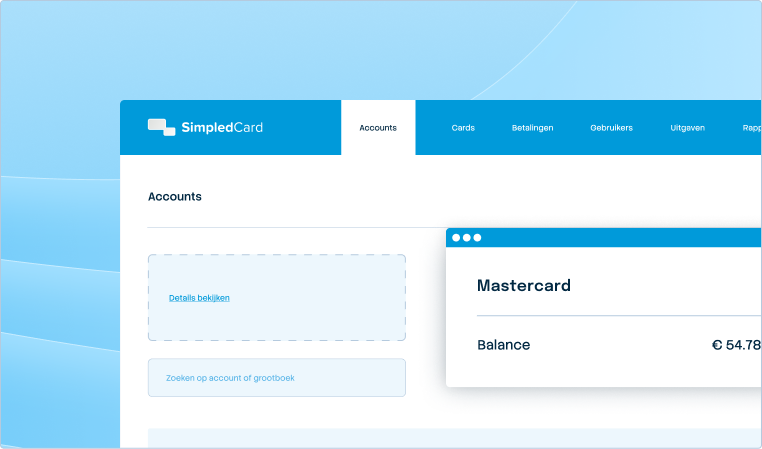
One of the options is SimpledCard's payment and claims solution. With it, you manage your budget limits and expenses. Via the corresponding dashboard you have real-time insight into the costs of your team and organisation, and immediately check whether the justification of expenses is correct.
In this way, SimpledCard helps you as a finance manager gain better control over company spending. As a result, you can have blind faith in your financial reporting.
Contact us about internal control
Do you have questions following the article on internal control? Or would you like more information on how to get a grip on employee spending with SimpledCard?
Then take contact us on, our experts will be happy to help.

From Christel Heije

Published on: July 20, 2021